Scorecard
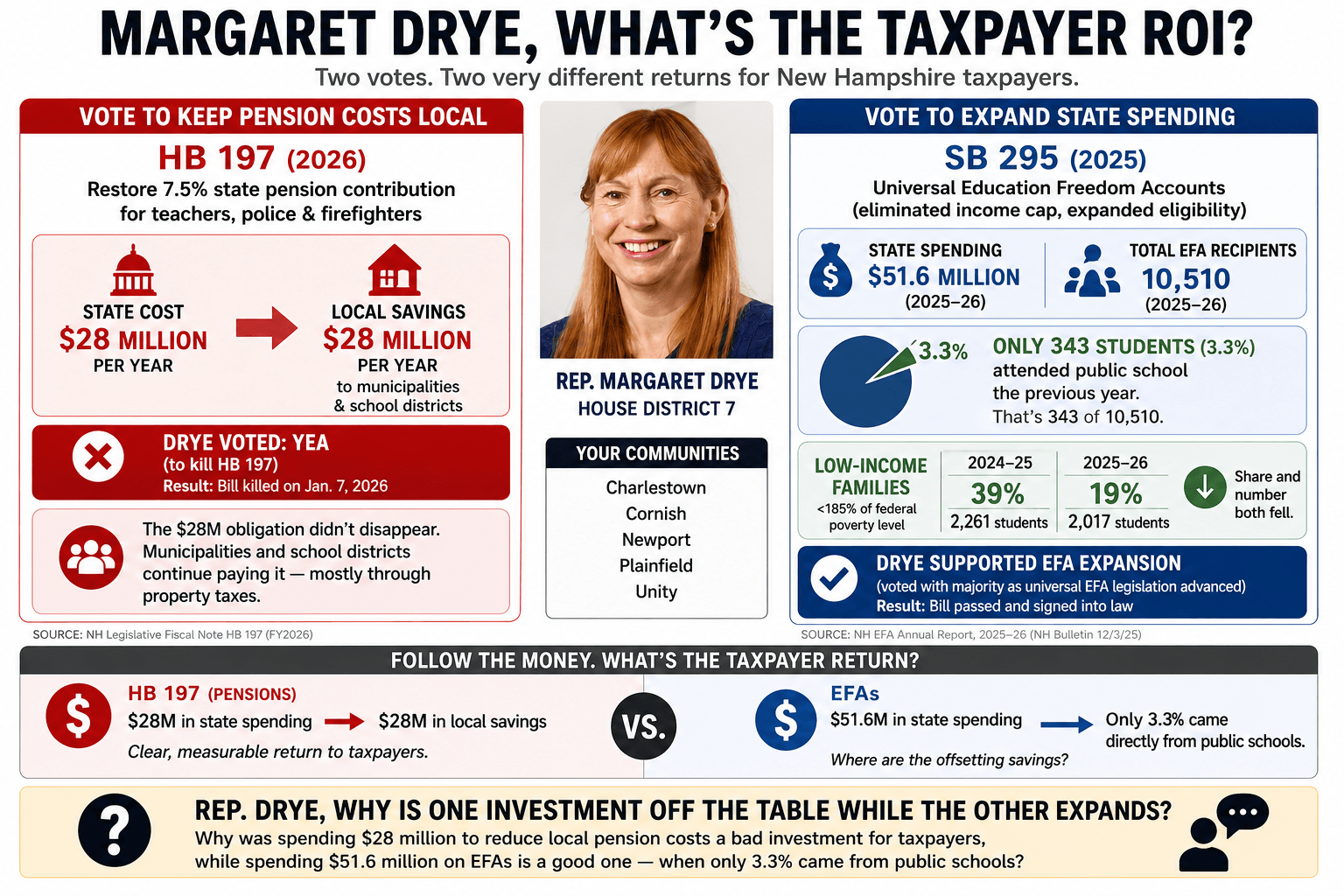
Margaret Drye, What's the Taxpayer ROI?
Two votes. Two very different returns for New Hampshire taxpayers.
Key finding
One vote rejected $28 million in state spending that carried a measurable, equal offset in local savings. The other supported $51.6 million in state spending whose offsetting local savings have not been demonstrated.
 (opens the full-size image in a new tab)
The comparison
Two bills, both about state spending, both with consequences that land locally.
HB 197 proposed that the state resume paying 7.5 percent of the employer pension contribution that municipalities and school districts make for teachers, police officers and firefighters. The legislative fiscal note prices that at $28 million a year to the state, and $28 million a year saved by local employers. That is an unusual property for a spending bill: the offset is equal, immediate and identifiable.
The bill was killed on January 7, 2026. The obligation it addressed did not go away. It is still paid, locally, mostly out of property taxes.
The Education Freedom Account expansion moved in the other direction. State spending for 2025-26 was $51.6 million across 10,510 recipients. Of those, 343 — 3.3 percent — had attended public school the year before.
The question this raises
If a district does not lose a student, it does not shed the cost of that student, so an account opened for a child who was already outside the public system does not produce a corresponding local saving. That is what makes the comparison worth making: one appropriation had a measured local offset and one does not have a published one.
That is a question about return, not a demonstration of harm. The honest form of it is the one printed on the graphic: why was $28 million to reduce local pension costs a bad investment for taxpayers, while $51.6 million on Education Freedom Accounts is a good one?
The HB 197 vote, verified
The General Court’s published roll call settles it. On January 7, 2026 the House voted on a motion of Inexpedient to Legislate on HB 197. The motion was adopted 172-159, which killed the bill. Representative Drye voted Yea — in favour of the motion.
That is worth stating carefully, because a Yea here is a vote against the bill. The graphic on this page labels it correctly.
What this page is not
This examines two decisions. It is not an account of Representative Drye’s record, and it should not be read as one.
The State Ledger’s own review of her votes found decisions it scores favourably alongside the two examined here — she cosponsored HB 1433 (2026), the child care tax credit that became law in July 2026, and sponsored the original HB 1268 (2026), the prescription drug bill whose final text added pharmacy benefit manager oversight. Both are too recent to evaluate on results. Neither is offset against the votes below; they are noted because a page that examined only the unfavourable ones would be making a claim about a record while showing part of it.
The SB 295 vote, verified
The graphic describes Drye as having “voted with majority as universal EFA legislation advanced”. The House took six roll calls on SB 295 across two days, so that phrase needed pinning to a specific vote. Two of the six settle it.
On June 5, 2025 the House adopted Ought to Pass with Amendment by 190-178 — passage of the bill. Drye voted Yea. A motion to reconsider that passage was rejected the same day, 171-198, and Drye voted Nay, against reopening it.
Both point the same way. She voted to pass universal EFA eligibility and then voted to let that passage stand.
Both sides of the comparison now rest on the record
This analysis no longer relies on any characterisation. Each vote it describes is a named roll call with a motion, a tally and a recorded position:
| Bill | Date | Motion | Result | Drye |
|---|---|---|---|---|
| HB 197 | Jan 7, 2026 | Inexpedient to Legislate | Adopted 172-159 | Yea |
| SB 295 | Jun 5, 2025 | Ought to Pass with Amendment | Adopted 190-178 | Yea |
| SB 295 | Jun 5, 2025 | Reconsider | Rejected 171-198 | Nay |
The first killed a bill that would have moved $28 million off local property tax bills. The second passed a $51.6 million expansion of state education spending. That is the comparison, and it is now sourced end to end.
What the evidence shows
- HB 197 (2026) would have restored a 7.5 percent state contribution toward employer pension costs for teachers, police officers and firefighters. The legislative fiscal note puts the state cost at $28 million per year and the corresponding saving to municipalities and school districts at $28 million per year.[1]
- On January 7, 2026 the House adopted a motion of Inexpedient to Legislate on HB 197 by 172-159, killing the bill. Representative Drye voted Yea on that motion — in favour of killing it. This is confirmed by House roll call 30, read directly from the General Court record.[2]
- The $28 million obligation did not disappear; municipalities and school districts continue to pay it, largely through property taxes.
- On June 5, 2025 the House passed SB 295, establishing universal Education Freedom Account eligibility, by 190-178 on a motion of Ought to Pass with Amendment. Representative Drye voted Yea. A motion to reconsider that passage failed the same day, 171-198, with Drye voting Nay — against reopening it. Confirmed by House roll calls 219 and 220.[3][4]
- EFA state spending for 2025-26 was $51.6 million across 10,510 recipients.[5][6]
- 343 of those recipients, or 3.3 percent, attended public school the previous year.[5][6]
- Representative Drye's district covers Charlestown, Cornish, Newport, Plainfield and Unity, and her party, district and committee are confirmed by the General Court's published member roster.[7]
What it does not show
- The roll call itself has not been re-checked against the General Court's published record. Two State Ledger graphics describe the HB 197 vote differently — one as a YEA on the motion that killed the bill, the other as a NO — and until that is reconciled against the record, this page states only that she acted to kill it.
- It does not establish that either vote changed any particular household's tax bill.
- A pension contribution and an education account are not the same kind of spending, and comparing their returns is an argument, not a measurement.
- The 3.3 percent figure measures prior-year enrolment, not what recipients would have done without the programme.
- It does not present the case for either vote in the words of the representative who cast it.
- Two votes are not a record. Drye also cosponsored HB 1433 and sponsored the original HB 1268, both of which became law in 2026 and both of which The State Ledger scores favourably; neither is examined here.