Commentary
Looking Past Sullivan’s Rhetoric: Which Families Come First?
Is this policy helping the average Granite Stater — or using their tax dollars to subsidize choices for families wealthy enough to make them without government assistance?
Main argument · in the author’s words
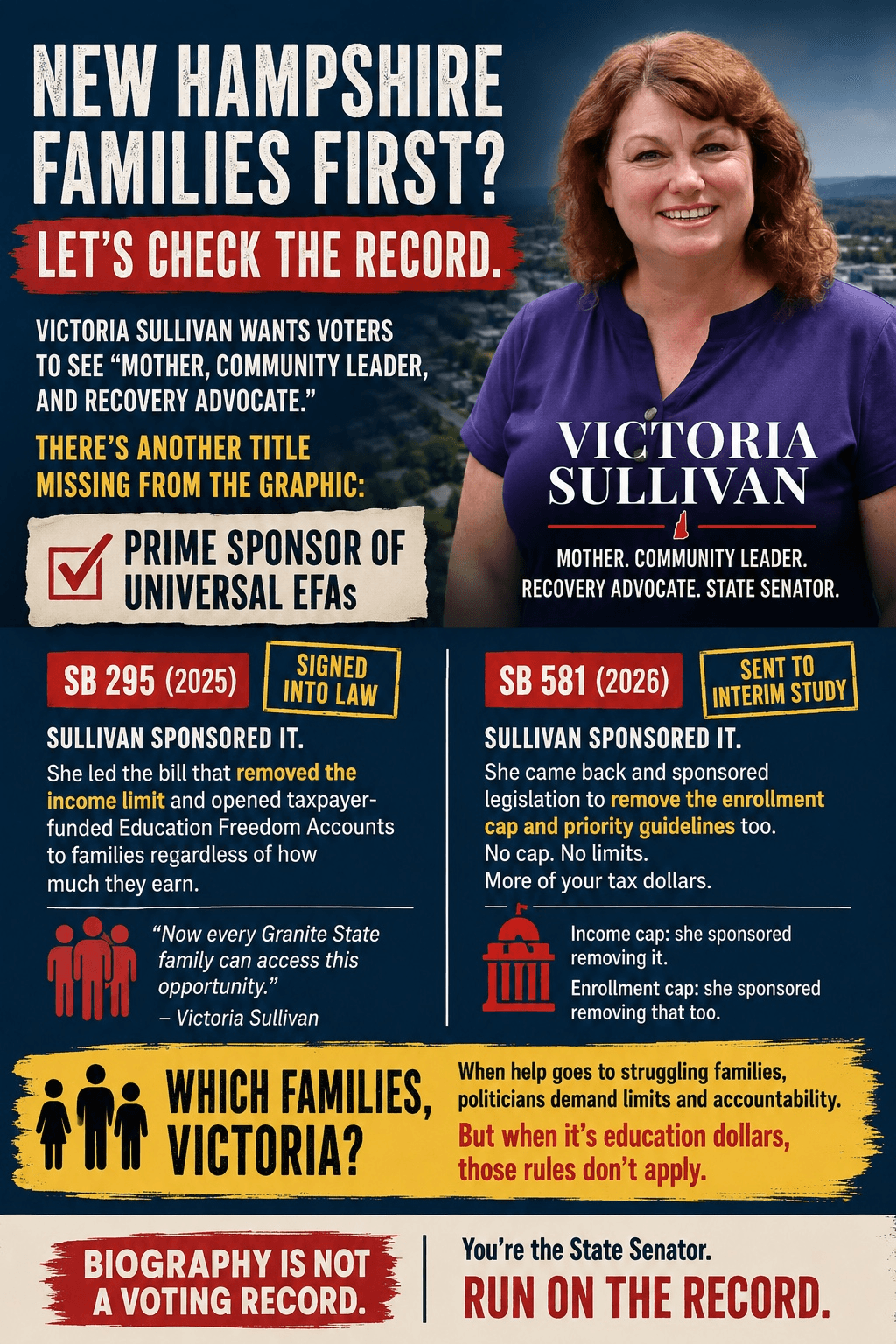
The issue is what she did with public policy while serving in the State Senate. Biography is not a voting record. Campaign graphics aren’t a voting record.
 (opens the full-size image in a new tab)
From the article
In 2026, Sullivan returned as the prime sponsor of SB 581, legislation proposing to remove the EFA enrollment cap and priority guidelines as well. The Senate sent that proposal to interim study, so the cap remains. But the legislation Sullivan chose to sponsor tells voters where she wanted the program to go.
Sullivan herself celebrated the 2025 expansion by saying: “Every Granite State family will be able to utilize this program.”
Supporters have a legitimate counterargument. They view EFAs as education funding rather than means-tested assistance and argue that families should have access to public education dollars regardless of income.
Under the policy Sullivan sponsored, even millionaire households can qualify for taxpayer-funded EFAs.
This isn’t an accusation about her motives. It isn’t an attack on her being a mother, community leader or recovery advocate. Those things aren’t the issue.
What the evidence shows
- Sullivan was the prime sponsor of SB 295 (2025), which expanded Education Freedom Accounts to families regardless of household income, subject to the program's enrollment structure.[1]
- In 2026 Sullivan was the prime sponsor of SB 581, which proposed removing the EFA enrollment cap and priority guidelines. The Senate sent it to interim study, so the cap remains.[2]
- Sullivan celebrated the 2025 expansion by saying, "Every Granite State family will be able to utilize this program."[3]
- The article states that some New Hampshire private schools charge tuition above $80,000 a year, and that the state remains in a years-long dispute over whether it adequately funds public-school students.
What it does not show
- The article says explicitly that it is not an accusation about Sullivan's motives, and not an attack on her as a mother, community leader or recovery advocate.
- It does not show how many higher-income households use EFAs, or what share of EFA money goes to them. It establishes that the law allows them to qualify, not how the accounts are being used.
- It acknowledges supporters' view that EFAs are education funding rather than means-tested aid, and does not test that argument against data.
- SB 581 did not pass. The enrollment cap and priority guidelines remain in place, so the second step of the "progression" the article describes is a proposal, not law.
← All articles & analysis · More on Education Freedom Accounts