Explainer
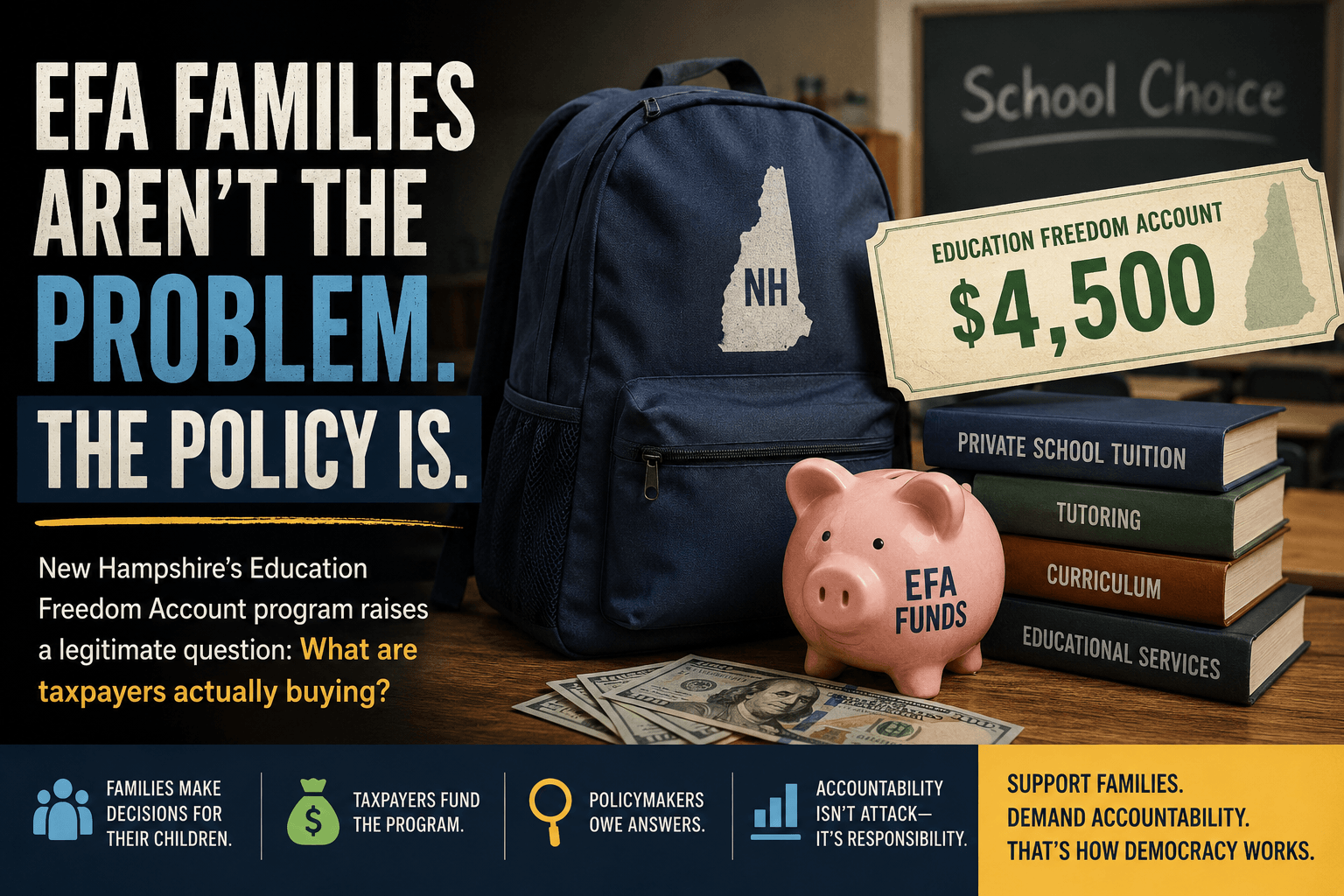
EFA Families Aren't the Problem. The Policy Is.
Enrollment growth measures demand. It does not measure whether the money changed anything.
Key finding
A family accepting a benefit the Legislature created is not responsible for proving the programme works. The government is. The useful question is not whether you support families who use Education Freedom Accounts, but what New Hampshire purchased with the money and how anyone would know.
 (opens the full-size image in a new tab)
The debate keeps becoming an argument about parents
That is convenient for everyone, because it avoids the harder question: what exactly are taxpayers buying?
If the state offers your family thousands of dollars toward an educational expense and you legally qualify, taking it is rational. The people who designed the programme, expanded it and appropriate money for it are the ones responsible for demonstrating that the expenditure accomplishes its purpose.
Accepting a subsidy is not evidence the subsidy works
Imagine the state offered homeowners $5,000 toward a mortgage. Thousands would apply. Applications would rise every year. None of that would tell anyone whether the programme achieved a public objective. It would tell you that people like receiving $5,000.
Enrollment growth is regularly presented as evidence that the EFA programme is succeeding. It is a measure of demand, not of impact — and as eligibility expands, the distinction matters more, not less.
Additionality, or expense substitution
Additionality is when the money causes something that would not otherwise have happened: a child who could not afford private school attends one, a homeschooling family gains specialised instruction it could not purchase, a student in a setting that is not working gains a viable alternative.
Expense substitution is when the activity was already happening and the state begins paying part of it. The family’s finances improve. The educational choice may not have changed at all.
That is not fraud and it is not a scam by any parent. It is a policy-design question, and it is worth tens of millions of dollars.
What New Hampshire should be able to answer
- How many recipients gained an opportunity they otherwise could not afford?
- How many were already purchasing essentially the same education?
- What are families buying, and who receives the payments?
- What educational outcomes result, and how have they changed as the programme has expanded?
These are not anti-school-choice questions. They are ordinary programme-evaluation questions, and they should be asked of any public expenditure of this size.
Parents are not the accountability mechanism
If you support EFAs, criticism of the programme becomes criticism of parents. If you oppose them, families receiving the money become part of the problem. Both moves are lazy, and both let the actual question go unanswered.
Asking the government to show what taxpayers received for tens of millions of dollars is not hostility toward children, families, homeschooling or private education. It is accountability.
What the evidence shows
- The Department of Education's 2023-24 demographic report identified 1,568 EFA students as public-school switchers, 37 percent of EFA enrollment at the time. Most participants in that snapshot were not classified as students who had switched from a public school.[1]
- The state calculated more than $27.6 million in EFA-related adequacy funding for 5,321 students in its September 2024 report.[2]
- A subsidy produces two distinguishable effects. Additionality: the money causes something that would not otherwise have happened. Expense substitution: the activity was already happening and the state begins paying part of it. Both are counted the same way in enrollment figures.
What it does not show
- It does not show that EFA money is wasted. A family already homeschooling or already paying tuition may gain real benefit — sustainability, tutoring, curriculum, specialised instruction it could not previously afford.
- It does not establish what share of the programme falls into each category. That is the point: the state does not publish the data that would separate them.
- It is not an argument against school choice. The same programme-evaluation questions should be asked of a public-school programme costing tens of millions of dollars.
- Nothing here is a claim about any individual family, or about anyone quoted in the exchange that prompted it. The argument is about programme design and what the state reports, not about who deserves the money.
← All articles & analysis · More on Education Freedom Accounts