Explainer
When the State Stops Paying, Somebody Else Starts
Downshifting is real, documented, and narrower than the argument usually made about it.
Key finding
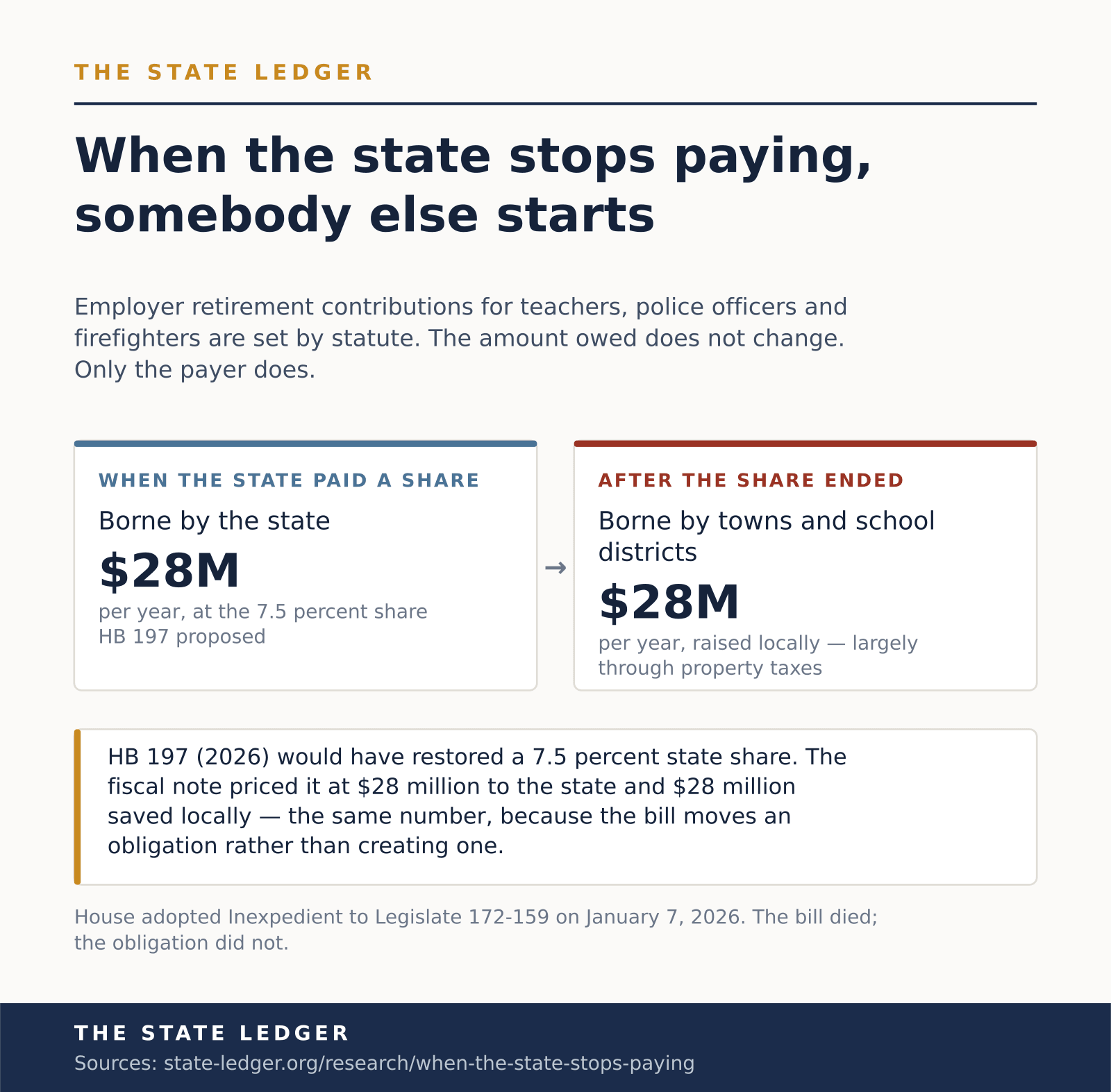
New Hampshire has a documented case of a cost moving from the state to its municipalities and staying there: the state's share of local retirement contributions. HB 197 would have restored part of it at $28 million a year, with an equal $28 million saving to towns and school districts. The House killed it in January 2026, and the obligation is still paid locally.
 (opens the full-size image in a new tab)
The mechanism
Downshifting names a specific move. The state reduces or ends its share of a cost that a municipality or school district is still legally required to pay. The state’s ledger improves. The obligation does not go away. It lands on the only broad-based tax a New Hampshire municipality has.
That is easy to assert and hard to prove, because most fiscal changes have several causes at once. What makes the retirement contribution useful is that it has only one.
The case that is actually documented
The state used to pay a share of the employer contributions that towns and school districts make to the New Hampshire Retirement System for teachers, police officers and firefighters. That share was reduced, then ended. The contribution itself is set by statute and did not change. Only the payer did.
In 2026 the House considered restoring part of it. HB 197 would have put the state back in for 7.5 percent. The legislative fiscal note prices that at $28 million a year to the state and $28 million a year saved by municipalities and school districts — the same number on both sides, because the bill moves an existing obligation rather than creating a new one.
On January 7, 2026 the House adopted a motion of Inexpedient to Legislate by 172-159. The bill died. The $28 million is still owed, and it is still raised locally.
That is downshifting with a price tag, a date and a roll call attached. It is the strongest version of the argument because none of it requires inference.
Why school funding is where this shows up most
For 2023-24, locally raised property taxes supplied about 61 percent of school district revenue. The Statewide Education Property Tax — collected and retained locally — added roughly 9 percent more. About seven dollars in ten of public school revenue came from property taxes.
The statutory figure the state sends is set in RSA 198:40-a: $4,100 per pupil, plus $2,300 for a pupil eligible for a free or reduced price meal, $800 for an English language learner and $2,100 for a pupil receiving special education services. No district in the state spends that little. The difference is the local share, and how large it is depends mostly on how much taxable property stands behind each student.
The distinction most arguments get wrong
Statewide adequacy aid rose between FY2025 and FY2026 — from about $1.064 billion to about $1.079 billion. In the same year, 145 municipalities received less of it than they had the year before.
Both statements are true. “State education funding went up” is accurate and tells a town that lost aid nothing at all. The question worth asking is never whether the statewide total moved; it is what happened in a specific place, and why.
Where this argument stops
The evidence establishes deliberate reduction of state revenue and subsequent budget pressure. It does not establish that every dollar the state chose not to collect reappeared as a dollar of property tax. Those are different claims, and only the first one is supported.
The record also contains things that cut the other way, and they belong in any honest version of this. The FY2026-27 budget maintained most recent municipal aid gains. Proposals to cut the municipal share of Meals and Rooms revenue failed. Enrolment has fallen by roughly 45,000 students since 2002-03, which is a real reason to question automatic aid growth. And the funding formula deliberately moves money toward poorer, property-poor communities, so some of what looks like a town being abandoned is a town being asked to give way to a poorer one.
The defensible claim is narrower than the slogan and harder to dismiss: follow a specific cost, and say who is paying it now.
What the evidence shows
- The state formerly paid a share of the employer contributions municipalities and school districts make to the New Hampshire Retirement System for teachers, police officers and firefighters. That share was reduced and then ended. The obligation is fixed by statute and did not change; only who pays it did.
- HB 197 (2026) proposed restoring a 7.5 percent state contribution. The legislative fiscal note prices it at $28 million a year to the state and $28 million a year saved by local employers — an unusual case where the offset is equal, immediate and identifiable. The House adopted Inexpedient to Legislate 172-159 on January 7, 2026, and the bill died.[3][2]
- For the 2023-24 school year, locally raised property taxes supplied about 61 percent of school district revenue. The Statewide Education Property Tax, also raised and retained locally, supplied roughly 9 percent more, so about 70 percent of public school revenue came from property taxes, per the New Hampshire Fiscal Policy Institute.[4]
- The statutory cost of an adequate education under RSA 198:40-a is $4,100 per pupil for the biennium beginning July 1, 2023, plus $2,300 for a pupil eligible for a free or reduced price meal, $800 for an English language learner and $2,100 for a pupil receiving special education services. Every district's actual cost per pupil exceeds its adequacy grant, and the difference is raised locally.[1]
- A statewide total can rise while individual communities lose. NHFPI's municipality-level analysis found 145 municipalities receiving less state adequacy aid in FY2026 than FY2025, while statewide adequacy aid rose from about $1.064 billion to about $1.079 billion. The issue is distribution, not a statewide cut.[4]
- Some targeted municipal support was reduced: state aid grants for wastewater infrastructure fell from $15 million in the prior budget to $2.5 million, per the New Hampshire Municipal Association.[5]
What it does not show
- It does not establish that every dollar of forgone state revenue became a dollar of property tax. That is a fiscal-capacity argument, not an accounting identity, and the distinction is the difference between a claim that survives scrutiny and one that does not.
- It does not establish that any particular household's bill rose, or why. A tax bill moves for municipal, school, county, state education tax, valuation and tax-base reasons at once.
- Downshifting is not new and is not the invention of any one legislative majority. New Hampshire's reliance on local property taxation is decades old and predates every majority currently serving.
- The record contains genuine counterevidence. The FY2026-27 budget maintained most recent municipal aid gains, and proposals to reduce municipalities' 30 percent share of Meals and Rooms revenue failed. A blanket claim that the state has dumped its costs onto towns is not supported.
- Falling enrolment is a legitimate complication. New Hampshire has roughly 45,000 fewer public school students than in 2002-03, which is a reasonable basis for questioning whether every district should receive continuously rising aid.
- The current funding formula deliberately targets more aid toward communities with higher poverty and lower property wealth, so some of the losses in the distribution above are redistribution rather than abandonment.
- NHFPI is a policy-analysis organisation rather than a state agency. Its modelled estimates are treated here as estimates.