Commentary
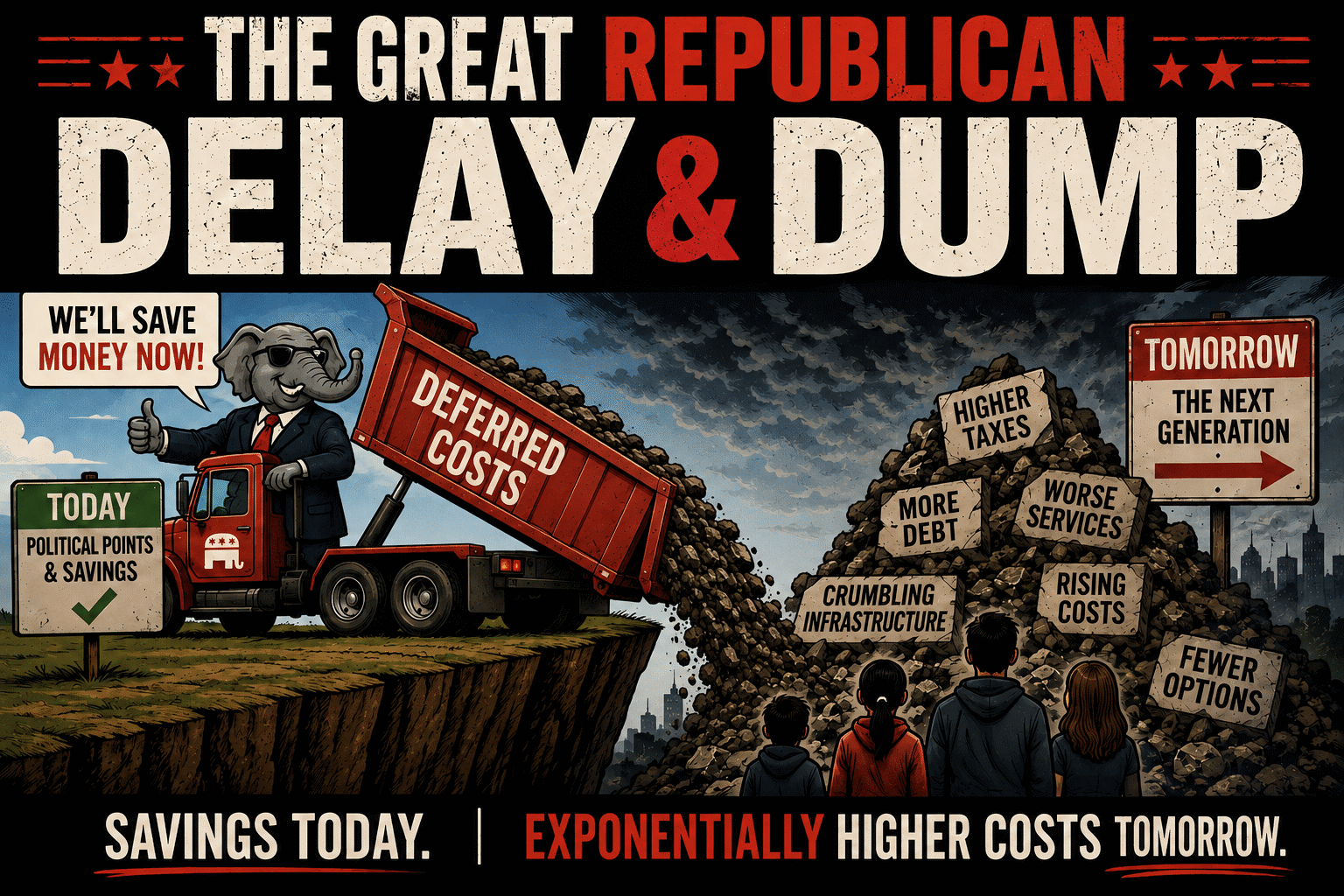
The Great Delay and Dump
Savings today. Higher costs tomorrow.
Update: Replaced the illustration with the author's corrected render, in which the truck discharges rearward over the tailgate, and noted among its limitations that the drawing uses partisan imagery.
Main argument
A cost that is deferred rather than eliminated does not leave the ledger. It is paid later, usually by a different set of people, and usually for more.
 (opens the full-size image in a new tab)
A note on the drawing
Two earlier versions of this illustration showed the truck discharging over its cab. A dump truck raises the front of the bed and discharges rearward, over the tailgate, behind the rear axle, so it has to be backed up to the edge with the cab pointing away from the drop. The version published here is corrected: the truck is backed up, and the load leaves from behind the raised bed.
It is a small thing, and it is the sort of small thing this site should get right. An illustration that could not happen is a poor advertisement for an argument about following evidence.
Why this is filed as commentary
The State Ledger publishes evidence. It also, occasionally, publishes argument. Mixing the two without saying which is which is how a research desk loses the thing that makes it worth reading, so this graphic carries a label and sits in its own content type.
The mechanism it depicts — a cost recorded as a saving because it has been postponed rather than removed — is real, and the analyses filed under Government Spending examine specific instances of it with figures attached.
What this graphic does that those analyses do not is assign the pattern to one party as a general characteristic. That is a political argument. It is offered as one, and a reader who wants the evidence rather than the argument should start with the analyses instead.
What the evidence shows
- The general mechanism it depicts is real and documented elsewhere on this site: deferring maintenance, pension contributions and building aid records a saving in one budget and an obligation in a later one.
What it does not show
- This is commentary, not analysis. It makes a partisan argument in partisan imagery — a party mascot, a party named in the title — and is filed accordingly. It illustrates a mechanism; it measures nothing.
- It does not quantify any specific deferred cost, name a bill or a budget line, or establish that any particular decision produced any particular later expense.
- It does not establish that deferral is exclusive to one party, or that every deferral is unjustified. Postponing a cost is sometimes the correct decision.
- The State Ledger's own research memo on New Hampshire governance concludes that the evidence supports a serious critique but not a blanket one. The sourced version of this idea is "When the State Stops Paying, Somebody Else Starts", which names a specific cost, a specific bill and a specific vote.