Commentary
NH Needed Money. Republicans Turned to People Who Could Least Afford It
When New Hampshire needed more money, who did lawmakers decide should carry more of the burden?
Main argument · in the author’s words
New Hampshire Republicans didn’t impose a new broad-based tax to raise this money. They turned instead to people who were already among the least able to afford another bill.
 (opens the full-size image in a new tab)
From the article
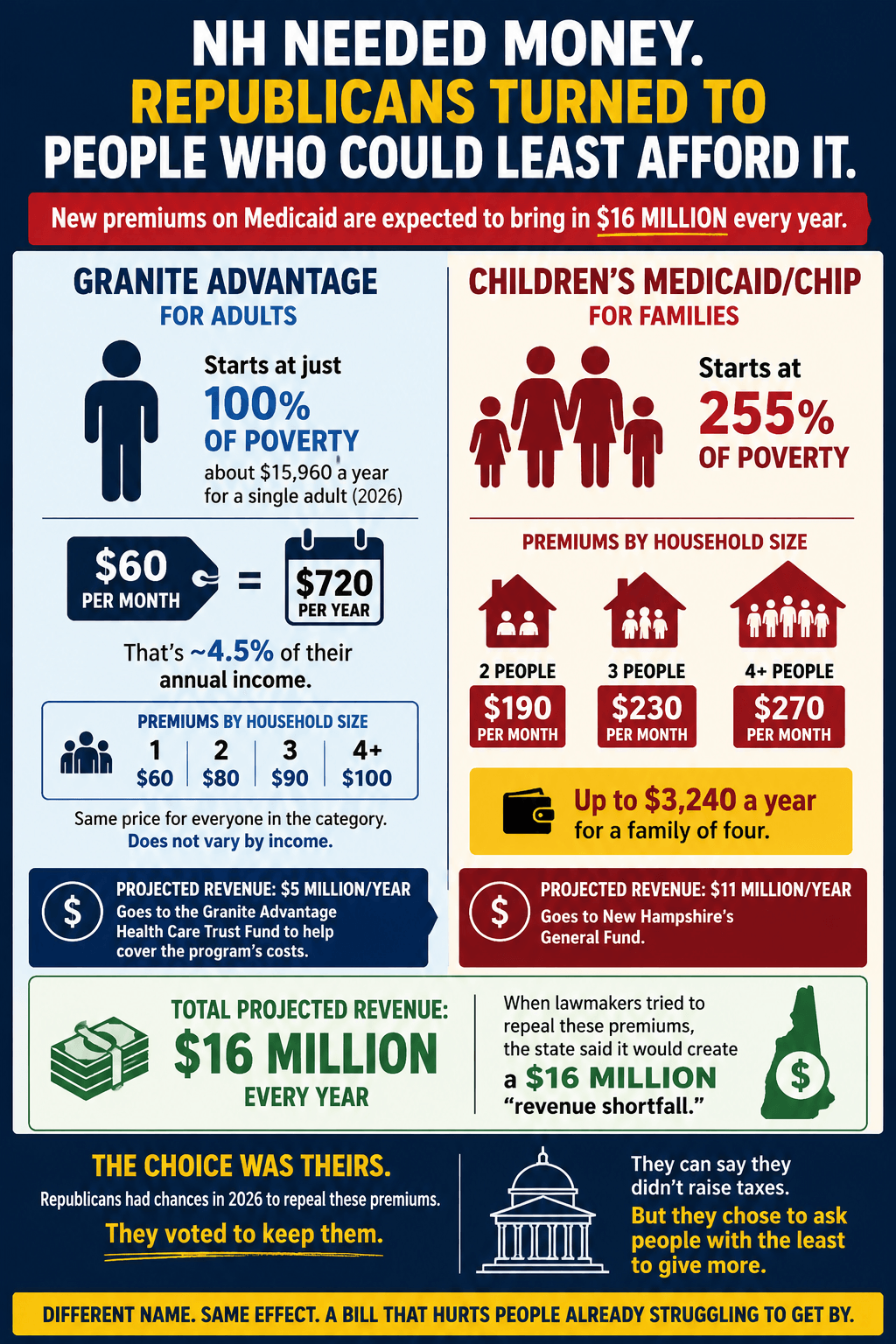
For someone right at the threshold, the premium consumes roughly 4.5 percent of their entire gross income.
There is an important distinction here. A family at 255 percent of poverty is in a very different financial position from a single adult at 100 percent.
So it would be inaccurate to say Republicans simply took $16 million from Medicaid recipients and spent it somewhere else.
Republicans can argue that premiums allow the state to preserve broader eligibility while asking some participating families to contribute toward the cost of their coverage.
But when presented with standalone opportunities to remove these charges, Republican majorities chose to keep them.
What the evidence shows
- Granite Advantage premiums begin at 100 percent of the federal poverty level, which the article puts at roughly $15,960 a year for a single person in 2026. A $60 monthly premium is $720 a year, about 4.5 percent of gross income at that threshold.[1][2]
- Granite Advantage premiums are $60 a month for one person, $80 for two, $90 for three and $100 for four or more, and within each household category they do not vary with the participant's income.[1]
- New premiums for families with children covered at or above 255 percent of the federal poverty level are $190 a month for a household of two, $230 for three and $270 for four or more, up to $3,240 a year.[1]
- The state projects roughly $16 million a year from the premiums: about $5 million from Granite Advantage, deposited in the Granite Advantage Health Care Trust Fund, and about $11 million from children's coverage premiums, deposited in the General Fund. The Legislative Budget Assistant estimated a $16 million annual shortfall if they were repealed.[3]
- In 2026 the Republican-controlled House killed HB 1760, which would have repealed the premiums and the increased prescription copays, and the Republican-controlled Senate rejected SB 484, which sought to repeal the premium system.[4][5]
What it does not show
- The article does not claim the premiums are taxes. The author says they are premiums, and that arguing over the label obscures the question of who pays.
- It does not say the money was taken from Medicaid recipients and spent elsewhere. The article notes that about $5 million stays in the Granite Advantage trust fund, and calls that version of the claim inaccurate.
- It acknowledges that a family at 255 percent of poverty is in a very different position from a single adult at the poverty line, and that Republicans can argue premiums help preserve relatively generous eligibility for children.
- It does not show how many people are paying the premiums, or whether any have lost or dropped coverage as a result.