Commentary
Everyone Has a Balance Sheet
New Hampshire lawmakers argue that taxes matter because businesses feel them directly. The same state is seeking to charge some people near the poverty line hundreds of dollars more for health care.
Main argument · in the author’s words
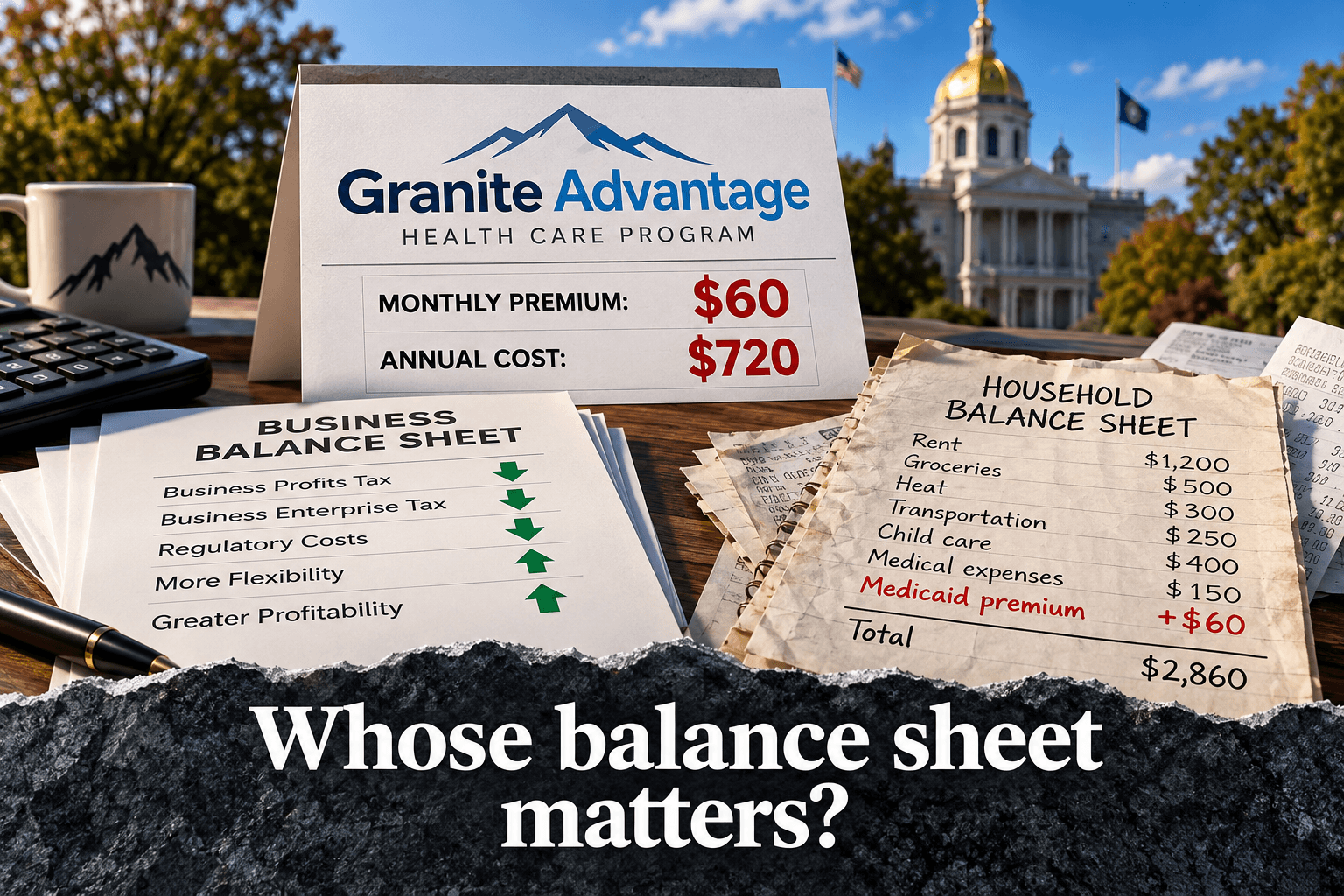
If lawmakers worry about what a fraction of a percentage point in business taxes does to a company’s balance sheet, why is $720 a year charged to someone living near the poverty line defended as “personal responsibility”? That is not a question about whether businesses matter. It is a question about whether everyone’s balance sheet matters equally.
 (opens the full-size image in a new tab)
From the article
The state directed DHHS to seek permission to make people with incomes beginning at the poverty level pay more toward their Medicaid coverage.
The law requires DHHS to establish hardship criteria, and federal limitations on Medicaid cost sharing still apply. The state also needs the necessary federal authorization before implementing the premiums.
Government may also be subsidizing part of the effective cost of private-sector labor.
Nor do we have evidence that Labrie’s own employees receive Medicaid. Their wages, household incomes and health coverage are not established by the evidence examined for this article, and it would be inappropriate to assume otherwise.
Whether New Hampshire should require that contribution is a legitimate policy debate. Supporters can argue that beneficiaries should contribute toward their coverage, that public programs must remain financially sustainable, and that eliminating the premiums simply transfers the expense somewhere else.
What the evidence shows
- Rep. Brian Labrie of Bedford wrote in NH Journal, "I don't need a policy memo to understand how regulation and taxation affect hiring decisions; I actually see it on my balance sheet," while arguing against increases in the Business Profits and Business Enterprise taxes and welcoming the defeat of HB 503.[1]
- RSA 126-AA:2-a, enacted through HB 2, directs DHHS to seek federal authorization for Granite Advantage premiums beginning at 100 percent of the federal poverty level: $60 a month for one person, $80 for two, $90 for three and $100 for four or more. The premium "shall not vary based on the participant's income," and the law requires hardship criteria.[2]
- HB 2 also directed premiums for some households with children enrolled through CHIP and raised applicable Medicaid prescription copays to $4, subject to federal requirements.[3]
- The Legislative Budget Assistant estimated that repealing these provisions would reduce expected state revenue by $16.75 million a year: about $5 million from Granite Advantage premiums, $11 million from CHIP premiums and $750,000 from prescription copays.[4]
- A 2026 GAO analysis estimated that 13.8 million working-age adults enrolled in Medicaid worked at some point in 2024, about two-thirds full time, and that 88 percent of working adults receiving Medicaid or SNAP were employed in the private sector.[5]
- The House Health, Human Services and Elderly Affairs Committee recommended killing HB 1760, the repeal bill, 10-8. Its majority said the cost-sharing was meant to promote "personal responsibility and program sustainability"; the minority warned people might skip prescriptions or delay care. On March 12, 2026 the House voted 184-153 to find the bill Inexpedient to Legislate.[6][7]
What it does not show
- The article states that it has no evidence Labrie's own employees receive Medicaid. Their wages, household incomes and coverage were not examined, and it says it would be inappropriate to assume otherwise.
- It does not suggest that employers whose workers rely on Medicaid have done anything illegal or improper, as the article says directly. The GAO figures are national, not New Hampshire employer data.
- The premiums require federal authorization and are subject to hardship criteria and federal cost-sharing limits. The article does not show that approval has been granted or how many people would pay.
- It does not establish that the premiums cause people to drop coverage or skip prescriptions. That is the committee minority's warning, which the article presents as one side of a policy debate.